
Is Your European Car Ready for Fall? 8 Maintenance Checks to Make Now

Fall brings cooler temperatures, changing road conditions, and longer periods of darkness. For European car owners, it is a good time to make sure the vehicle is prepared for the months ahead. A seasonal inspection can help identify worn components, fluid issues, electrical problems, and other concerns before they become more disruptive. Whether you drive a BMW, Mercedes-Benz, Audi, Volkswagen, Volvo, MINI, Porsche, or another European vehicle, regular maintenance is important for keeping your car dependable and performing as intended. European vehicles often use sophisticated electronic systems and specialized components. That means routine maintenance and accurate diagnostics can be especially important when something does not feel quite right. Before fall driving gets underway, here are eight maintenance checks worth putting on your list. 1. Check Your Tires and Tire Pressure Your tires are one of the most important components to inspect as temperatures begin to drop. Tire pressure naturally changes with temperature, so a tire that was properly inflated during the warmer months may need attention as the weather cools. Check the pressure in all four tires and compare it with the manufacturer’s recommended specification. Do not rely on the number printed on the tire sidewall. That number represents the tire’s maximum pressure rather than necessarily the correct pressure for your vehicle. While checking pressure, inspect the tires for: Uneven tread wear Cracks or visible damage Bulges or deformities Excessively worn tread Objects embedded in the tread Signs of improper alignment Uneven wear can sometimes point to an alignment or suspension issue rather than simply an aging tire. Addressing the underlying problem can help prevent additional tire wear. If your European vehicle uses a tire pressure monitoring system, make sure there are no warning lights or unusual readings. A professional inspection can help determine whether a pressure issue is caused by a tire, valve, sensor, or another problem. 2. Inspect the Brakes Fall means changing weather and road conditions. Wet roads, leaves, and reduced visibility can all make dependable braking especially important. Pay attention to how your brakes feel and sound. Warning signs can include: Squealing or grinding noises Vibration when braking A soft or spongy brake pedal Pulling to one side while braking Longer stopping distances A brake warning light Brake components can wear at different rates depending on the vehicle, driving habits, and conditions. Performance-oriented European vehicles may also have braking systems designed around higher levels of power and performance. During a brake inspection, a technician can evaluate the condition of the brake pads, rotors, calipers, brake fluid, and other related components. If you have noticed a change in braking performance, fall is not the time to ignore it. Having the system inspected before colder and wetter conditions arrive can help you address potential problems early. 3. Test the Battery and Charging System Cooler weather can put additional demands on a vehicle’s battery. If the battery is already aging or its performance has declined, lower temperatures can make starting problems more likely. Look for signs such as: Slow engine cranking Flickering interior or exterior lights Electrical accessories behaving unusually A battery warning light Needing multiple attempts to start the vehicle However, the battery is only one part of the vehicle’s starting and charging system. The alternator, starter, wiring, and electrical connections can also contribute to starting or charging problems. This is particularly important with modern European vehicles because many rely on sophisticated electrical systems and numerous control modules. A weak battery or charging issue can sometimes trigger multiple warning messages. A battery and charging-system test can provide a better picture of the system’s condition before the weather gets colder. 4. Check Your Fluids Fluids play an important role in engine operation, braking, cooling, and other vehicle systems. Fall is a good opportunity to check fluid levels and look for signs of contamination or leaks. Depending on your vehicle, this may include: Engine oil Coolant Brake fluid Transmission fluid Power steering fluid Windshield washer fluid Not every European vehicle uses the same fluids or service procedures. Some newer models also have sealed systems or specific manufacturer requirements. That is why it is important to use the correct fluid specifications for your particular vehicle rather than simply choosing a generic product. Coolant deserves particular attention before temperatures fall. The cooling system does more than protect against overheating during hot weather. Proper coolant concentration also helps protect the system during colder conditions. If you notice fluid underneath your vehicle, a drop in fluid level, or a warning light on the dashboard, have the vehicle inspected rather than simply topping the fluid off and continuing to drive. 5. Inspect the Wipers and Windshield Clear visibility becomes increasingly important as fall brings rain, fog, and shorter daylight hours. Wiper blades can deteriorate over time due to heat and sun exposure. By the time fall arrives, they may leave streaks, skip across the glass, or fail to clear water effectively. Inspect your wipers for: Cracked or split rubber Streaking Skipping Squeaking Areas of the windshield that remain uncleared Check the windshield washer system as well. Make sure the reservoir is filled with an appropriate washer fluid and that the spray nozzles work correctly. It is also worth inspecting the windshield for chips or cracks. Small damage can sometimes spread when temperatures change. Addressing windshield damage early may help prevent a minor issue from becoming a larger one. 6. Test Your Lights With daylight hours getting shorter, you will likely spend more time driving in darkness. Your vehicle’s lighting system needs to be ready for that change. Check your: Headlights Brake lights Turn signals Parking lights Reverse lights Fog lights, if equipped Hazard lights Do not only check whether the bulbs turn on. Pay attention to whether the headlights appear dim, whether one side looks different from the other, or whether a warning appears on the dashboard. Modern European vehicles can use advanced lighting systems with LED technology, adaptive functions, and electronic controls. If a lighting system is malfunctioning, the issue may involve more
7 Mistakes You’re Making with Your European Car’s AC This Texas Summer (and How to Fix Them)

If you’ve lived in Central Texas for more than five minutes, you know that July and August aren’t just “warm”: they are a test of human endurance. For drivers in Pflugerville, TX, your car isn’t just a way to get from point A to point B; it’s a mobile cooling station. But when you’re driving a precision-engineered machine like a BMW, Audi, or Mercedes-Benz, the air conditioning system operates with a level of complexity that your average commuter car just doesn’t have. At United Euro, we’ve spent over 25 years seeing exactly what the Texas sun does to European cooling systems. Our team, led by Moe (a Honda/Acura Master Technician) and Felix (our expert Service Writer), has diagnosed thousands of AC issues. Most of the time, the “failure” isn’t a broken part: it’s a series of small mistakes the owner is making that eventually leads to a very expensive repair. If you want to keep your cabin frosty while the asphalt is melting on I-35, avoid these seven common mistakes. 1. Using “Max AC” the Second You Get In We get it. You open the door, and the interior of your car feels like the inside of a convection oven. Your first instinct is to hop in, crank the dial to “Max AC” or “Lo,” and blast the fans. The Fix: European cars often have “intelligent” climate control systems. Blasting the AC immediately forces the compressor to work at maximum capacity while trying to cool air that is already 140 degrees inside the cabin. Instead, roll down all your windows for the first 60 seconds of your drive. This lets the hot air escape naturally. Once the interior temperature matches the outside air, roll the windows up and let the AC take over. You’ll find it reaches a comfortable temperature much faster and puts less strain on your system. 2. Ignoring the Cabin Air Filter Many drivers think the cabin air filter is just a “dealership upsell.” In reality, for a BMW repair shop or a Mercedes service center, it’s one of the most critical maintenance items for AC health. European cars are designed with very tight tolerances. A clogged filter doesn’t just make the air smell a bit dusty; it restricts the airflow over the evaporator coil. When airflow is restricted, the coil can actually freeze over, turning your AC into a literal block of ice that won’t blow any air at all. The Fix: Replace your cabin air filter every 12,000 miles, or more often if you’re driving through the dusty construction zones around Pflugerville. If you can’t remember the last time it was changed, it’s probably time to visit an Audi specialist near me for a quick check. 3. Reaching for the “Death Kit” (DIY Refrigerant Cans) This is perhaps the most dangerous mistake for European car owners. You see those “AC Pro” cans at the big-box auto parts stores? Stay away from them. Modern European vehicles use highly specific amounts of refrigerant (often R134a or the newer R1234yf). These systems are sensitive down to the gram. The gauges on those DIY cans are notoriously inaccurate. If you overcharge the system, you can blow the seals on your compressor or cause “slugging,” which destroys the compressor instantly. The Fix: If your AC isn’t cold, it’s because there is a leak or a component failure. Adding more gas is a temporary fix that masks a bigger problem. Professional AC repairs involve a vacuum test to find the leak and a precision recharge using factory-spec equipment. 4. Skipping the Condenser Cleaning Your AC condenser sits right at the very front of your car, usually just in front of the radiator. Its job is to shed the heat that the AC system pulled out of your cabin. In Texas, the condenser becomes a magnet for grasshoppers, road grime, and leaf debris. When the condenser is dirty, it can’t dissipate heat. This causes the high-side pressure in your AC system to skyrocket, which makes the compressor run hotter and wear out years earlier than it should. The Fix: During your regular scheduled maintenance, ask your technician to inspect the condenser for debris. A simple rinse with a low-pressure hose can often save you thousands in compressor replacement costs down the road. 5. Shutting the Car Off While the AC is Blasting Do you ever notice a “gym locker” smell when you first turn on your car? That’s because of moisture. When you run the AC on a humid Texas afternoon and then abruptly shut the car off, condensation stays trapped on the evaporator. This dark, damp environment is the perfect breeding ground for mold and bacteria. The Fix: About two minutes before you reach your destination in Pflugerville, turn off the AC button but keep the fans running. This helps dry out the evaporator and prevents that funky smell from developing. It’s a small habit that makes a massive difference in your car’s air quality. 6. Not Using the “Recirculate” Button Correctly There is a common misconception that you should always leave the AC on “Fresh Air” mode to get oxygen. While fresh air is good, it also means your AC has to constantly take 100-degree humid air and cool it down to 40 degrees. The Fix: Use the “Recirculate” button once the cabin has cooled down. This allows the system to pull in the air that it has already cooled and dehumidified, making its job much easier. Most modern Mercedes and BMW models have an “Auto” mode that handles this for you, but it’s always good to keep an eye on it during a record-breaking heatwave. 7. Waiting for a Breakdown to Visit a Professional The biggest mistake we see at United Euro is the “if it ain’t broke, don’t fix it” mentality. By the time your AC is blowing hot air, the damage is already done. European AC systems are integrated into the car’s main computer. A failing sensor or a small leak in a high-pressure hose can
Performance Upgrades 101: Enhancing Your European Ride Without Sacrificing Reliability

There is a specific thrill that comes with owning a European car. Whether it’s the clinical precision of a BMW, the refined luxury of a Mercedes-Benz, or the understated muscle of an Audi, these vehicles are engineered for a superior driving experience. But for many enthusiasts, “factory stock” is just the starting line. You want more: more throttle response, sharper cornering, and a bit more growl when you step on it. The challenge, however, is the “reliability” bogeyman. We’ve all heard the horror stories: someone gets a generic tune or a cheap set of coilovers, and suddenly their pride and joy is a permanent resident of a repair shop. At United Euro, we’ve spent over 25 years proving that you don’t have to choose between a faster car and a reliable one. For drivers in Pflugerville, TX, looking for a balance of speed and longevity, it all starts with a smart plan. The Foundation: Why “Stage 0” Matters Most Before you even think about adding a single horsepower, you have to talk about maintenance. In the world of European auto repair, we call this “Stage 0.” You cannot build a skyscraper on a cracked foundation, and you certainly shouldn’t put a high-boost tune on an engine with old spark plugs and tired ignition coils. Our Master Technician, Moe, has spent decades working on high-performance Asian and European platforms. He’ll tell you that the most effective “performance mod” you can do is a fresh oil change with high-quality synthetic oil and a cooling system flush. European engines: especially turbocharged ones from BMW and Audi: run hot. If your cooling system isn’t 100% healthy, adding more power is a recipe for a blown head gasket or a warped head. Before we start any upgrade project at our BMW repair shop near Pflugerville, we perform a comprehensive health check. We look for oil leaks, check the health of your battery, and ensure your drivetrain can actually handle the extra torque you’re about to throw at it. Handling First: The Joy of a Sharp Suspension Most people think performance means “engine,” but in many cases, the biggest transformation happens in the chassis. If you’re driving throughout Pflugerville and find your car feels a bit “floaty” or nose-dives when you hit the brakes, a suspension upgrade is your best friend. Upgrading to a set of high-quality lowering springs or adjustable coilovers doesn’t just make the car look better: it lowers the center of gravity and reduces body roll. When combined with a professional alignment, your car will feel lighter and more responsive. However, there is a limit. Going too low or too stiff can ruin the ride quality and put unnecessary stress on your bushings and ball joints. This is where specialized expertise comes in. At United Euro, we help you select components that provide a sporty feel without making your daily commute feel like a bouncy castle. We prioritize “streetable” performance that respects the original engineering of your vehicle. Breathing Better: Intakes and Exhausts An internal combustion engine is essentially a giant air pump. The more air you can get in and out efficiently, the more power you can make. Cold Air Intakes: A quality intake system can improve throttle response and give your engine a more aggressive sound. The key here is “quality.” Cheap intakes often pull hot air from the engine bay, which actually hurts performance. We look for sealed systems that draw cool, dense air from outside. Custom Exhaust Systems: Beyond the sound, a high-flow exhaust system reduces backpressure. For turbocharged Mercedes or Audi engines, this is critical because it allows the turbo to spool up faster. If you’ve been searching for an Audi specialist near me to help your car find its voice, our team can guide you toward systems that sound great without the dreaded “drone” on the highway. Check out our thoughts on why enthusiasts trust us for custom exhaust installations. The “Magic Wand”: ECU Tuning Modern European cars are controlled by sophisticated computers. Manufacturers often detune engines from the factory to account for poor fuel quality in different parts of the world or to fit into specific insurance brackets. An ECU (Engine Control Unit) tune can unlock significant power by optimizing fuel maps, ignition timing, and boost pressure. A “Stage 1” tune is typically designed for a stock car and is one of the most cost-effective ways to gain 20–50 horsepower. The danger lies in “off-the-shelf” tunes that push the limits too far. At our Mercedes service center for drivers in Pflugerville, we advocate for conservative tunes that keep all the factory safety parameters intact. If the engine gets too hot or detects bad fuel, the computer should still be able to pull back power to protect itself. Reliability isn’t just about the parts; it’s about the software that manages them. Stopping Power: Don’t Forget the Brakes If you’re going to go faster, you absolutely must be able to stop faster. High-performance brake pads and cross-drilled or slotted rotors are essential supporting mods. They dissipate heat better than stock components, which prevents “brake fade” during spirited driving or emergency stops. Upgrading your brake lines to stainless steel versions can also improve pedal feel, giving you more confidence when you’re navigating the curves near Pflugerville. When you visit us, Felix, our expert Service Writer, can walk you through the different pad compounds: from low-dust ceramic pads for daily driving to more aggressive pads for the weekend track enthusiast. Why United Euro? We aren’t just a repair shop; we are car people. With over 25 years of experience in the industry, we’ve seen every trend come and go. Our team is led by Moe, a Master Technician who treats every car like his own, and Felix, who ensures you understand exactly what’s happening with your vehicle every step of the way. We specialize in the brands that require a delicate touch: Audi, Volkswagen, Mercedes-Benz, BMW, and high-performance Asian makes like Acura, Honda, Toyota, and Lexus. We use advanced
Cracking the Code: How Advanced Engine Diagnostics Save You From Costly Guesses

We’ve all been there: you’re driving down the road in Pflugerville, enjoying the performance of your BMW or the reliability of your Honda, when that glowing amber “Check Engine” light flickers onto your dashboard. Your heart sinks. Is it a loose gas cap, or is your engine about to give up the ghost? In the world of auto repair, there are two ways to handle that light. One is the “Parts Cannon” approach: guessing which part might be broken and replacing it, hoping the light goes out. The other is advanced engine diagnostics, a data-driven process that identifies the root cause before a single wrench is turned. At United Euro, we believe in the latter. Precision isn’t just a buzzword for us; it’s the foundation of how we save our customers time, money, and stress. The Problem with the “Parts Cannon” If you’ve ever taken your car to a big-box parts store and had them “read the code” for free, you might think you have the answer. The scanner says “P0420 – Catalyst System Efficiency Below Threshold,” so you buy a $1,500 catalytic converter. You install it, drive ten miles, and: bing: the light is back. That is the “Parts Cannon” in action. A trouble code is not a diagnosis; it’s a starting point. It tells us which system is seeing a problem, not necessarily which part has failed. That P0420 code could be a bad sensor, an exhaust leak, or even a simple software update. Without proper testing, you’re just gambling with your bank account. Why Precision Diagnostics Matter for Modern Vehicles Modern vehicles: especially the European and Asian makes we specialize in: are essentially rolling computers. A typical Audi, Mercedes-Benz, or Lexus has dozens of interconnected modules communicating via complex networks. When something goes wrong in a BMW repair shop environment, we don’t just look at one code. We look at “freeze-frame” data: a snapshot of exactly what was happening the moment the error occurred. Was the engine hot or cold? What was the fuel pressure? How fast were you going? This level of detail is essential for: European Auto Repair: Brands like BMW and Mercedes require specialized factory-level software to access deep-system modules that generic scanners can’t reach. Asian Car Repair: Precise tuning in brands like Acura and Lexus means even a tiny vacuum leak can trigger multiple warning lights. Meet the Experts: Moe and Felix At United Euro, you aren’t just getting a guy with a scanner. You’re getting over 25 years of industry excellence. Moe, our Honda/Acura Master Technician, has spent decades mastering the intricate engineering of Asian vehicles. Whether it’s a complex hybrid system or a high-performance VTEC engine, Moe’s diagnostic approach is surgical. He doesn’t guess; he proves. On the front end, you have Felix, our Honda/Acura Service Writer. Felix is the bridge between the technical data and you. He excels at taking complex diagnostic results and explaining them in plain English, ensuring you understand exactly what your car needs and why. Together, they ensure that your Honda repair shop experience is transparent, professional, and accurate. Real-World Savings: Diagnostics in Action Let’s look at how advanced engine diagnostics actually save you money. Here are a few common scenarios we see for drivers in and around Pflugerville: The “Misfire” Mystery (Code P0300) A “Parts Cannon” shop might tell you that you need all new spark plugs and ignition coils for your Toyota, costing you hundreds of dollars. Our Approach: We perform a “pinpoint test.” We might find that the issue is actually a single leaking intake gasket or a clogged fuel injector. The Result: You pay for the specific repair needed, often saving 50% or more over a “replace everything” approach. The “Limp Mode” Scare If your Mercedes-Benz suddenly loses power and won’t shift, it’s terrifying. A dealership might suggest a new transmission. Our Approach: We use advanced Mercedes-specific diagnostics to check the Transmission Control Module (TCM). Often, it’s a simple wiring fault or a software reflash. The Result: A few hundred dollars in specialized labor versus thousands for a transmission you didn’t need. Specialized Care for Your Make and Model Every manufacturer has its quirks. Our team knows them inside and out. Audi Specialist Near Me: We understand the unique timing chain and turbocharger diagnostic requirements for Audi’s precision engines. Lexus Car Maintenance: We keep your luxury ride smooth by diagnosing suspension and sensor issues before they impact your drive. Toyota Service Near Me: From Prius hybrids to Tundra trucks, we provide the reliable maintenance Pflugerville families depend on. Flexible Financing for Peace of Mind We know that even with accurate diagnostics, car repairs can sometimes be an unexpected expense. Because we want to keep our neighbors safe on the road, we offer flexible financing options through Synchrony, SNAP Finance, and Acima. We also accept all major extended service contracts, making us a cost-effective alternative to dealership pricing. The United Euro Difference At the end of the day, a car is one of your biggest investments. Treating it with “guesses” isn’t just inefficient: it’s risky. By investing in a professional diagnostic fee, you are actually buying insurance against unnecessary repairs. Whether you need a Mercedes service center you can trust or a reliable place for Asian car repair, our team is here to provide clarity. We use the same advanced equipment as the big dealerships, but with the personalized, cost-effective approach of a local, family-owned shop. Conclusion Don’t let a dashboard light ruin your week. Instead of firing the “parts cannon” and hoping for the best, bring your vehicle to the experts who know how to crack the code. With Moe’s master-level technical skills and Felix’s commitment to clear communication, we’ll get to the bottom of the issue and get you back on the road with confidence. Ready for a clear answer? Schedule your diagnostic appointment with United Euro today and experience the difference that 25 years of expertise makes for Pflugerville drivers.
Do You Really Need ADAS Calibration After an Alignment? Here’s the Truth for European Car Owners
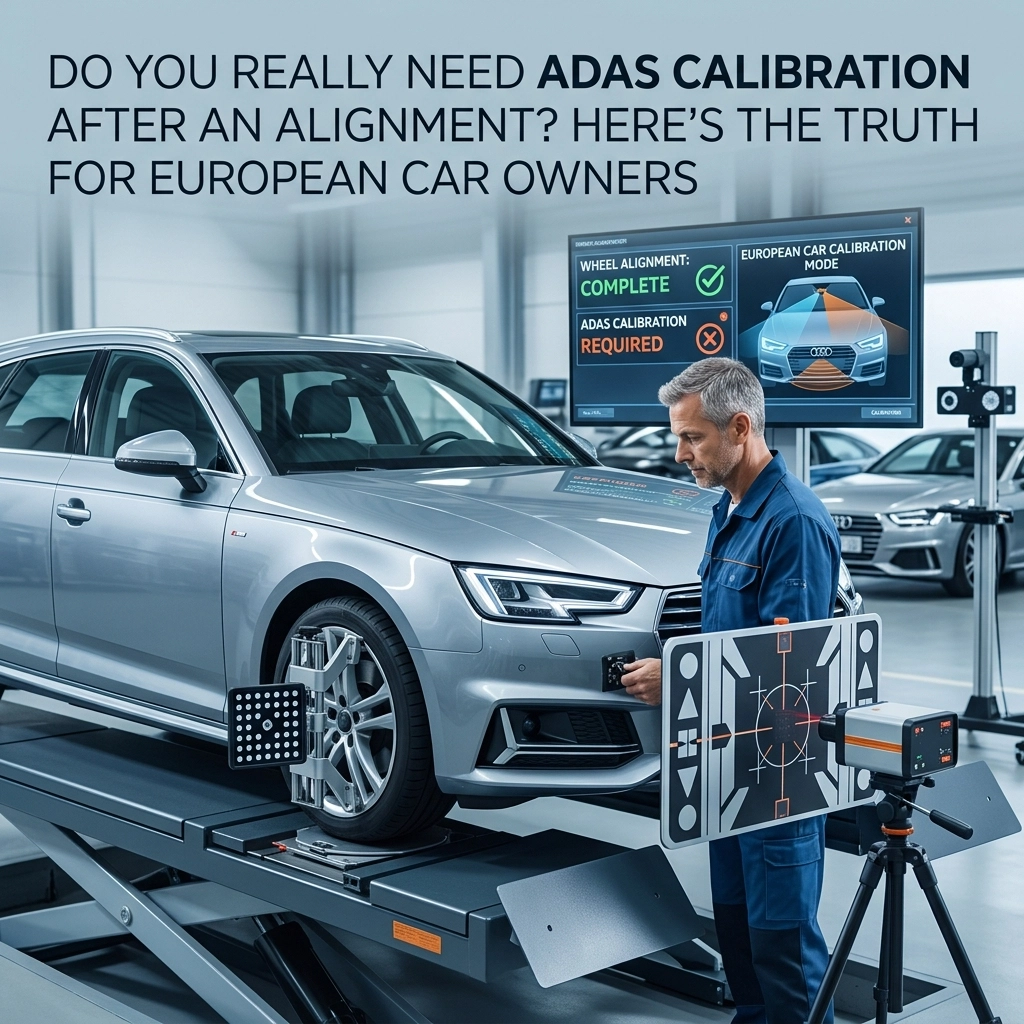
You’ve likely been there: cruising down the SH-130 in your BMW or Mercedes, enjoying that tight, German-engineered handling, when you notice the steering wheel is just a hair off-center. Or maybe you’ve recently hit one of those notorious Texas potholes and noticed your Audi is pulling slightly to the right. Naturally, you think, “I just need a quick wheel alignment.” In the old days: say, back in 2010: you’d be right. You’d drop your car off at a European auto repair shop, the technician would adjust your tie rods, and you’d be back on the road in an hour. But if you’re driving a modern European vehicle equipped with Advanced Driver Assistance Systems (ADAS), an alignment is no longer a “set it and forget it” mechanical job. Today, if you align the wheels without calibrating the “eyes” of the car, you might be setting yourself up for a digital headache: or worse, a safety hazard. At United Euro, our master technicians, Moe and Felix, see this confusion all the time. Let’s break down the truth about why ADAS calibration isn’t just an “upsell”: it’s a safety necessity for every modern Audi, BMW, Mercedes, and VW owner in Pflugerville. What is ADAS, and Why Does Your Car Have So Many “Eyes”? Before we dive into the mechanical weeds, let’s define the tech. ADAS stands for Advanced Driver Assistance Systems. These are the features you’ve grown to love (and perhaps occasionally argue with): Adaptive Cruise Control: Keeping you at a safe distance from the truck in front of you. Lane Keep Assist: Gently nudging your steering wheel if you drift. Automatic Emergency Braking: Slamming on the anchors if a pedestrian steps out. Blind Spot Monitoring: Those little orange triangles in your mirrors. These systems rely on a complex network of cameras (usually behind the rearview mirror), radar sensors (often hidden in the front grille or bumper), and ultrasonic sensors. For these systems to work, they need to know exactly where the car is pointing. The Technical Connection: Why Alignment and ADAS are Inseparable Think of your car’s wheel alignment as its “posture” and the ADAS sensors as its “vision.” When we perform a wheel alignment, we are adjusting the angles of the wheels so they are parallel to each other and perpendicular to the ground. We specifically look at the Thrust Angle: the direction the rear wheels are pointing. In a perfect world, the rear wheels push the car exactly down the center of the chassis. However, when a technician adjusts your alignment, they are fundamentally changing the “Thrust Line” of the vehicle. If the wheels were pointing even 0.5 degrees off before, and now they are perfectly straight, the physical direction of the car has changed. The “Crooked Glasses” Analogy Imagine you’re wearing a pair of high-tech augmented reality glasses that highlight the path you should walk on. If someone nudges those glasses just two millimeters to the left, you’re going to start walking into walls, even if your feet are pointed straight ahead. That is exactly what happens to your BMW or Mercedes. If the alignment changes but the front-facing camera isn’t recalibrated to the new “straight,” the car’s computer thinks it’s heading one way while the wheels are actually taking it another. This is why what you should know about wheel balancing and alignment often involves more than just the tires. The Risks: What Happens if You Skip Calibration? Skipping ADAS calibration after an alignment isn’t just a technical oversight; it has real-world consequences on the roads of Pflugerville. 1. “Ghost” Emergency Braking This is perhaps the most frightening scenario. If your radar sensor is misaligned by even a fraction of a degree, it might perceive an overhead bridge or a car in the adjacent lane as an obstacle directly in your path. Your car might suddenly slam on the brakes at highway speeds for no apparent reason. 2. Lane Drift and Fighting the Wheel If your Lane Keep Assist thinks the “center” of the lane is three feet to the left of where it actually is, you’ll find yourself constantly fighting the steering wheel. The car will try to “correct” your position into oncoming traffic or the shoulder because its digital map doesn’t match its physical orientation. 3. False Warnings and System Failure Modern European ECUs (Electronic Control Units) are incredibly smart. If the data from the Steering Angle Sensor (SAS) doesn’t match the data from the camera and radar, the system may get “confused” and shut down entirely, lighting up your dashboard like a Christmas tree. The European Difference: Audi, BMW, and Mercedes Specs At United Euro, we specialize in German engineering. Why does that matter for ADAS? Because brands like Audi and Mercedes-Benz have some of the tightest tolerances in the industry. BMW Repair Shop Insights: On most modern BMWs, the Steering Angle Sensor must be reset during an alignment. If the car has Active Steering, the calibration is even more intensive. We use factory-quality diagnostics to ensure the electronic “zero point” matches the mechanical “zero point.” Mercedes Service Center Standards: Mercedes-Benz vehicles often use a “Distronic” radar system. If the bumper was removed or the alignment was adjusted, the radar must be recalibrated using specific targets to ensure the Adaptive Cruise Control doesn’t fail. Audi Specialist Perspective: Audi’s “Pre-Sense” system is highly integrated. An Audi specialist near me (that’s us!) knows that even a minor suspension tweak requires a look at the camera calibration to ensure your safety features remain functional. How United Euro Handles Calibration Many general repair shops in the Austin area will perform an alignment but then tell you to “go to the dealer” for the ADAS work. This is because ADAS calibration requires a massive investment in specialized equipment and training. Moe and Felix, our master technicians, don’t believe in half-measures. When you bring your vehicle to United Euro, we use bi-directional controls to talk directly to your car’s computer. We utilize specialized targets and laser-guided levels to ensure that
5 Warning Signs You Need Brake Repair Services Now

You’re cruising through Pflugerville, perhaps heading toward a weekend getaway or simply navigating the daily commute in your BMW or Honda. You press the brake pedal to slow down for a red light, and for a split second, there’s a flicker of hesitation. Maybe it’s a faint squeak, or perhaps the pedal feels just a bit softer than it did last month. In a high-performance European machine or a precision-engineered Asian vehicle, the braking system is your most critical safety feature. It is the literal line between a controlled stop and a dangerous collision. Yet, because brake wear is often gradual, many drivers subconsciously adapt to failing performance until it’s too late. At United Euro, we believe that maintaining your vehicle shouldn’t involve guesswork. With over 25 years of excellence and a team led by Certified Master Technicians Moe and Felix, we’ve seen how small warning signs can escalate into costly repairs. Understanding these five warning signs isn’t just about vehicle maintenance; it’s about protecting your investment and your family. 1. The Auditory Alarm: Squealing, Chirping, or Grinding Your car is designed to talk to you. When it comes to the braking system, the first “conversation” usually involves high-pitched noises. Most modern brake pads are equipped with a small metal shim called a wear indicator. When the friction material on the pad wears down to a specific thickness: usually around 2-3mm: this metal shim makes contact with the rotor, producing a distinct squealing or chirping sound. This is an intentional “early warning” designed by engineers to tell you that you need brake repair services within the next few weeks. However, if that squeal evolves into a heavy, metallic grinding sound, you have entered the danger zone. Grinding indicates that the friction material is completely gone. You are now experiencing metal-on-metal contact between the brake caliper and the rotor. For owners of European brands like BMW or Audi, this is particularly critical. European braking systems often utilize softer rotor compounds to achieve superior stopping power and “bite.” When you allow pads to reach the grinding stage, you aren’t just replacing pads; you are likely destroying the rotors and potentially damaging the calipers. In our European auto repair facility, we prioritize catching these issues early to save you the expense of a full system overhaul. 2. The Spongy or Soft Brake Pedal The braking system in your vehicle is a closed hydraulic circuit. When you press the pedal, you are moving brake fluid through lines to engage the calipers. If the pedal feels “spongy,” “mushy,” or sinks all the way to the floorboard, the hydraulic integrity has been compromised. There are three primary culprits for a soft pedal: Air in the Lines: Air is compressible; brake fluid is not. If air enters the system, your foot’s pressure is spent compressing air bubbles rather than moving the brake pads. Moisture Contamination: Brake fluid is hygroscopic, meaning it absorbs moisture from the air over time. This moisture lowers the boiling point of the fluid. Under heavy braking, the water can turn into vapor, creating that “spongy” feel and reducing stopping power. Master Cylinder Failure: Think of the master cylinder as the “heart” of your braking system. If the internal seals fail, the pressure required to stop your car will bleed off internally. Whether you drive a high-revving Honda or a luxury Mercedes, a soft pedal is a non-negotiable safety hazard. At United Euro, we utilize expert diagnostics to pinpoint exactly where the pressure loss is occurring, ensuring your “pedal feel” is restored to factory specifications. 3. Vibrations and Shaking During Deceleration If your steering wheel shudders or your brake pedal pulsates when you apply pressure, you are likely dealing with “warped” rotors. Technically known as lateral runout or thickness variation, this occurs when the surface of the brake rotor is no longer perfectly flat. Rotors are subject to immense thermal stress. Repeated heavy braking generates heat that can reach over 1,000 degrees Fahrenheit. If the rotors cannot dissipate this heat effectively, or if they are subjected to sudden cooling (like driving through a deep puddle after a long descent), the metal can distort. For Pflugerville drivers, this isn’t just an annoyance; it’s a performance killer. A vibrating rotor prevents the brake pads from making consistent, even contact. This reduces the friction coefficient and increases the time it takes to stop. As a specialized BMW repair shop and Honda repair shop, we see this often. We don’t just “slap on pads”; we measure rotor runout with precision instruments to ensure a vibration-free experience. 4. The “Pull” to One Side When you apply the brakes, your car should maintain a straight path. If the vehicle tries to dive into the left or right lane, you have an imbalance in your braking force. This “pulling” sensation usually points to a “stuck” or “frozen” brake caliper. In a healthy system, the caliper pistons move outward to press the pads against the rotor and then retract slightly when you release the pedal. If a caliper piston becomes seized due to corrosion or debris, it may stay engaged (causing the car to pull toward that side) or fail to engage entirely (causing the car to pull toward the opposite, working side). Other causes can include a collapsed brake hose that acts as a one-way valve, or unevenly worn pads. This behavior is especially dangerous in wet or slippery conditions, where an imbalanced brake force can trigger a skid. Our team, led by Moe and Felix, treats this as a holistic issue, checking everything from the hydraulic lines to the wheel balancing to ensure your car tracks straight and true. 5. Increased Stopping Distance and “Fading” Physics is unforgiving. If your car takes noticeably longer to come to a complete stop, your braking efficiency has dropped. This is often the result of “brake fade.” Brake fade occurs when the friction components (pads and rotors) can no longer convert kinetic energy into heat effectively. This can happen because the pads have