
7 Mistakes You’re Making with Your European Car’s AC This Texas Summer (and How to Fix Them)

If you’ve lived in Central Texas for more than five minutes, you know that July and August aren’t just “warm”: they are a test of human endurance. For drivers in Pflugerville, TX, your car isn’t just a way to get from point A to point B; it’s a mobile cooling station. But when you’re driving a precision-engineered machine like a BMW, Audi, or Mercedes-Benz, the air conditioning system operates with a level of complexity that your average commuter car just doesn’t have. At United Euro, we’ve spent over 25 years seeing exactly what the Texas sun does to European cooling systems. Our team, led by Moe (a Honda/Acura Master Technician) and Felix (our expert Service Writer), has diagnosed thousands of AC issues. Most of the time, the “failure” isn’t a broken part: it’s a series of small mistakes the owner is making that eventually leads to a very expensive repair. If you want to keep your cabin frosty while the asphalt is melting on I-35, avoid these seven common mistakes. 1. Using “Max AC” the Second You Get In We get it. You open the door, and the interior of your car feels like the inside of a convection oven. Your first instinct is to hop in, crank the dial to “Max AC” or “Lo,” and blast the fans. The Fix: European cars often have “intelligent” climate control systems. Blasting the AC immediately forces the compressor to work at maximum capacity while trying to cool air that is already 140 degrees inside the cabin. Instead, roll down all your windows for the first 60 seconds of your drive. This lets the hot air escape naturally. Once the interior temperature matches the outside air, roll the windows up and let the AC take over. You’ll find it reaches a comfortable temperature much faster and puts less strain on your system. 2. Ignoring the Cabin Air Filter Many drivers think the cabin air filter is just a “dealership upsell.” In reality, for a BMW repair shop or a Mercedes service center, it’s one of the most critical maintenance items for AC health. European cars are designed with very tight tolerances. A clogged filter doesn’t just make the air smell a bit dusty; it restricts the airflow over the evaporator coil. When airflow is restricted, the coil can actually freeze over, turning your AC into a literal block of ice that won’t blow any air at all. The Fix: Replace your cabin air filter every 12,000 miles, or more often if you’re driving through the dusty construction zones around Pflugerville. If you can’t remember the last time it was changed, it’s probably time to visit an Audi specialist near me for a quick check. 3. Reaching for the “Death Kit” (DIY Refrigerant Cans) This is perhaps the most dangerous mistake for European car owners. You see those “AC Pro” cans at the big-box auto parts stores? Stay away from them. Modern European vehicles use highly specific amounts of refrigerant (often R134a or the newer R1234yf). These systems are sensitive down to the gram. The gauges on those DIY cans are notoriously inaccurate. If you overcharge the system, you can blow the seals on your compressor or cause “slugging,” which destroys the compressor instantly. The Fix: If your AC isn’t cold, it’s because there is a leak or a component failure. Adding more gas is a temporary fix that masks a bigger problem. Professional AC repairs involve a vacuum test to find the leak and a precision recharge using factory-spec equipment. 4. Skipping the Condenser Cleaning Your AC condenser sits right at the very front of your car, usually just in front of the radiator. Its job is to shed the heat that the AC system pulled out of your cabin. In Texas, the condenser becomes a magnet for grasshoppers, road grime, and leaf debris. When the condenser is dirty, it can’t dissipate heat. This causes the high-side pressure in your AC system to skyrocket, which makes the compressor run hotter and wear out years earlier than it should. The Fix: During your regular scheduled maintenance, ask your technician to inspect the condenser for debris. A simple rinse with a low-pressure hose can often save you thousands in compressor replacement costs down the road. 5. Shutting the Car Off While the AC is Blasting Do you ever notice a “gym locker” smell when you first turn on your car? That’s because of moisture. When you run the AC on a humid Texas afternoon and then abruptly shut the car off, condensation stays trapped on the evaporator. This dark, damp environment is the perfect breeding ground for mold and bacteria. The Fix: About two minutes before you reach your destination in Pflugerville, turn off the AC button but keep the fans running. This helps dry out the evaporator and prevents that funky smell from developing. It’s a small habit that makes a massive difference in your car’s air quality. 6. Not Using the “Recirculate” Button Correctly There is a common misconception that you should always leave the AC on “Fresh Air” mode to get oxygen. While fresh air is good, it also means your AC has to constantly take 100-degree humid air and cool it down to 40 degrees. The Fix: Use the “Recirculate” button once the cabin has cooled down. This allows the system to pull in the air that it has already cooled and dehumidified, making its job much easier. Most modern Mercedes and BMW models have an “Auto” mode that handles this for you, but it’s always good to keep an eye on it during a record-breaking heatwave. 7. Waiting for a Breakdown to Visit a Professional The biggest mistake we see at United Euro is the “if it ain’t broke, don’t fix it” mentality. By the time your AC is blowing hot air, the damage is already done. European AC systems are integrated into the car’s main computer. A failing sensor or a small leak in a high-pressure hose can
Performance Upgrades 101: Enhancing Your European Ride Without Sacrificing Reliability

There is a specific thrill that comes with owning a European car. Whether it’s the clinical precision of a BMW, the refined luxury of a Mercedes-Benz, or the understated muscle of an Audi, these vehicles are engineered for a superior driving experience. But for many enthusiasts, “factory stock” is just the starting line. You want more: more throttle response, sharper cornering, and a bit more growl when you step on it. The challenge, however, is the “reliability” bogeyman. We’ve all heard the horror stories: someone gets a generic tune or a cheap set of coilovers, and suddenly their pride and joy is a permanent resident of a repair shop. At United Euro, we’ve spent over 25 years proving that you don’t have to choose between a faster car and a reliable one. For drivers in Pflugerville, TX, looking for a balance of speed and longevity, it all starts with a smart plan. The Foundation: Why “Stage 0” Matters Most Before you even think about adding a single horsepower, you have to talk about maintenance. In the world of European auto repair, we call this “Stage 0.” You cannot build a skyscraper on a cracked foundation, and you certainly shouldn’t put a high-boost tune on an engine with old spark plugs and tired ignition coils. Our Master Technician, Moe, has spent decades working on high-performance Asian and European platforms. He’ll tell you that the most effective “performance mod” you can do is a fresh oil change with high-quality synthetic oil and a cooling system flush. European engines: especially turbocharged ones from BMW and Audi: run hot. If your cooling system isn’t 100% healthy, adding more power is a recipe for a blown head gasket or a warped head. Before we start any upgrade project at our BMW repair shop near Pflugerville, we perform a comprehensive health check. We look for oil leaks, check the health of your battery, and ensure your drivetrain can actually handle the extra torque you’re about to throw at it. Handling First: The Joy of a Sharp Suspension Most people think performance means “engine,” but in many cases, the biggest transformation happens in the chassis. If you’re driving throughout Pflugerville and find your car feels a bit “floaty” or nose-dives when you hit the brakes, a suspension upgrade is your best friend. Upgrading to a set of high-quality lowering springs or adjustable coilovers doesn’t just make the car look better: it lowers the center of gravity and reduces body roll. When combined with a professional alignment, your car will feel lighter and more responsive. However, there is a limit. Going too low or too stiff can ruin the ride quality and put unnecessary stress on your bushings and ball joints. This is where specialized expertise comes in. At United Euro, we help you select components that provide a sporty feel without making your daily commute feel like a bouncy castle. We prioritize “streetable” performance that respects the original engineering of your vehicle. Breathing Better: Intakes and Exhausts An internal combustion engine is essentially a giant air pump. The more air you can get in and out efficiently, the more power you can make. Cold Air Intakes: A quality intake system can improve throttle response and give your engine a more aggressive sound. The key here is “quality.” Cheap intakes often pull hot air from the engine bay, which actually hurts performance. We look for sealed systems that draw cool, dense air from outside. Custom Exhaust Systems: Beyond the sound, a high-flow exhaust system reduces backpressure. For turbocharged Mercedes or Audi engines, this is critical because it allows the turbo to spool up faster. If you’ve been searching for an Audi specialist near me to help your car find its voice, our team can guide you toward systems that sound great without the dreaded “drone” on the highway. Check out our thoughts on why enthusiasts trust us for custom exhaust installations. The “Magic Wand”: ECU Tuning Modern European cars are controlled by sophisticated computers. Manufacturers often detune engines from the factory to account for poor fuel quality in different parts of the world or to fit into specific insurance brackets. An ECU (Engine Control Unit) tune can unlock significant power by optimizing fuel maps, ignition timing, and boost pressure. A “Stage 1” tune is typically designed for a stock car and is one of the most cost-effective ways to gain 20–50 horsepower. The danger lies in “off-the-shelf” tunes that push the limits too far. At our Mercedes service center for drivers in Pflugerville, we advocate for conservative tunes that keep all the factory safety parameters intact. If the engine gets too hot or detects bad fuel, the computer should still be able to pull back power to protect itself. Reliability isn’t just about the parts; it’s about the software that manages them. Stopping Power: Don’t Forget the Brakes If you’re going to go faster, you absolutely must be able to stop faster. High-performance brake pads and cross-drilled or slotted rotors are essential supporting mods. They dissipate heat better than stock components, which prevents “brake fade” during spirited driving or emergency stops. Upgrading your brake lines to stainless steel versions can also improve pedal feel, giving you more confidence when you’re navigating the curves near Pflugerville. When you visit us, Felix, our expert Service Writer, can walk you through the different pad compounds: from low-dust ceramic pads for daily driving to more aggressive pads for the weekend track enthusiast. Why United Euro? We aren’t just a repair shop; we are car people. With over 25 years of experience in the industry, we’ve seen every trend come and go. Our team is led by Moe, a Master Technician who treats every car like his own, and Felix, who ensures you understand exactly what’s happening with your vehicle every step of the way. We specialize in the brands that require a delicate touch: Audi, Volkswagen, Mercedes-Benz, BMW, and high-performance Asian makes like Acura, Honda, Toyota, and Lexus. We use advanced
Cracking the Code: How Advanced Engine Diagnostics Save You From Costly Guesses

We’ve all been there: you’re driving down the road in Pflugerville, enjoying the performance of your BMW or the reliability of your Honda, when that glowing amber “Check Engine” light flickers onto your dashboard. Your heart sinks. Is it a loose gas cap, or is your engine about to give up the ghost? In the world of auto repair, there are two ways to handle that light. One is the “Parts Cannon” approach: guessing which part might be broken and replacing it, hoping the light goes out. The other is advanced engine diagnostics, a data-driven process that identifies the root cause before a single wrench is turned. At United Euro, we believe in the latter. Precision isn’t just a buzzword for us; it’s the foundation of how we save our customers time, money, and stress. The Problem with the “Parts Cannon” If you’ve ever taken your car to a big-box parts store and had them “read the code” for free, you might think you have the answer. The scanner says “P0420 – Catalyst System Efficiency Below Threshold,” so you buy a $1,500 catalytic converter. You install it, drive ten miles, and: bing: the light is back. That is the “Parts Cannon” in action. A trouble code is not a diagnosis; it’s a starting point. It tells us which system is seeing a problem, not necessarily which part has failed. That P0420 code could be a bad sensor, an exhaust leak, or even a simple software update. Without proper testing, you’re just gambling with your bank account. Why Precision Diagnostics Matter for Modern Vehicles Modern vehicles: especially the European and Asian makes we specialize in: are essentially rolling computers. A typical Audi, Mercedes-Benz, or Lexus has dozens of interconnected modules communicating via complex networks. When something goes wrong in a BMW repair shop environment, we don’t just look at one code. We look at “freeze-frame” data: a snapshot of exactly what was happening the moment the error occurred. Was the engine hot or cold? What was the fuel pressure? How fast were you going? This level of detail is essential for: European Auto Repair: Brands like BMW and Mercedes require specialized factory-level software to access deep-system modules that generic scanners can’t reach. Asian Car Repair: Precise tuning in brands like Acura and Lexus means even a tiny vacuum leak can trigger multiple warning lights. Meet the Experts: Moe and Felix At United Euro, you aren’t just getting a guy with a scanner. You’re getting over 25 years of industry excellence. Moe, our Honda/Acura Master Technician, has spent decades mastering the intricate engineering of Asian vehicles. Whether it’s a complex hybrid system or a high-performance VTEC engine, Moe’s diagnostic approach is surgical. He doesn’t guess; he proves. On the front end, you have Felix, our Honda/Acura Service Writer. Felix is the bridge between the technical data and you. He excels at taking complex diagnostic results and explaining them in plain English, ensuring you understand exactly what your car needs and why. Together, they ensure that your Honda repair shop experience is transparent, professional, and accurate. Real-World Savings: Diagnostics in Action Let’s look at how advanced engine diagnostics actually save you money. Here are a few common scenarios we see for drivers in and around Pflugerville: The “Misfire” Mystery (Code P0300) A “Parts Cannon” shop might tell you that you need all new spark plugs and ignition coils for your Toyota, costing you hundreds of dollars. Our Approach: We perform a “pinpoint test.” We might find that the issue is actually a single leaking intake gasket or a clogged fuel injector. The Result: You pay for the specific repair needed, often saving 50% or more over a “replace everything” approach. The “Limp Mode” Scare If your Mercedes-Benz suddenly loses power and won’t shift, it’s terrifying. A dealership might suggest a new transmission. Our Approach: We use advanced Mercedes-specific diagnostics to check the Transmission Control Module (TCM). Often, it’s a simple wiring fault or a software reflash. The Result: A few hundred dollars in specialized labor versus thousands for a transmission you didn’t need. Specialized Care for Your Make and Model Every manufacturer has its quirks. Our team knows them inside and out. Audi Specialist Near Me: We understand the unique timing chain and turbocharger diagnostic requirements for Audi’s precision engines. Lexus Car Maintenance: We keep your luxury ride smooth by diagnosing suspension and sensor issues before they impact your drive. Toyota Service Near Me: From Prius hybrids to Tundra trucks, we provide the reliable maintenance Pflugerville families depend on. Flexible Financing for Peace of Mind We know that even with accurate diagnostics, car repairs can sometimes be an unexpected expense. Because we want to keep our neighbors safe on the road, we offer flexible financing options through Synchrony, SNAP Finance, and Acima. We also accept all major extended service contracts, making us a cost-effective alternative to dealership pricing. The United Euro Difference At the end of the day, a car is one of your biggest investments. Treating it with “guesses” isn’t just inefficient: it’s risky. By investing in a professional diagnostic fee, you are actually buying insurance against unnecessary repairs. Whether you need a Mercedes service center you can trust or a reliable place for Asian car repair, our team is here to provide clarity. We use the same advanced equipment as the big dealerships, but with the personalized, cost-effective approach of a local, family-owned shop. Conclusion Don’t let a dashboard light ruin your week. Instead of firing the “parts cannon” and hoping for the best, bring your vehicle to the experts who know how to crack the code. With Moe’s master-level technical skills and Felix’s commitment to clear communication, we’ll get to the bottom of the issue and get you back on the road with confidence. Ready for a clear answer? Schedule your diagnostic appointment with United Euro today and experience the difference that 25 years of expertise makes for Pflugerville drivers.
Do You Really Need ADAS Calibration After an Alignment? Here’s the Truth for European Car Owners
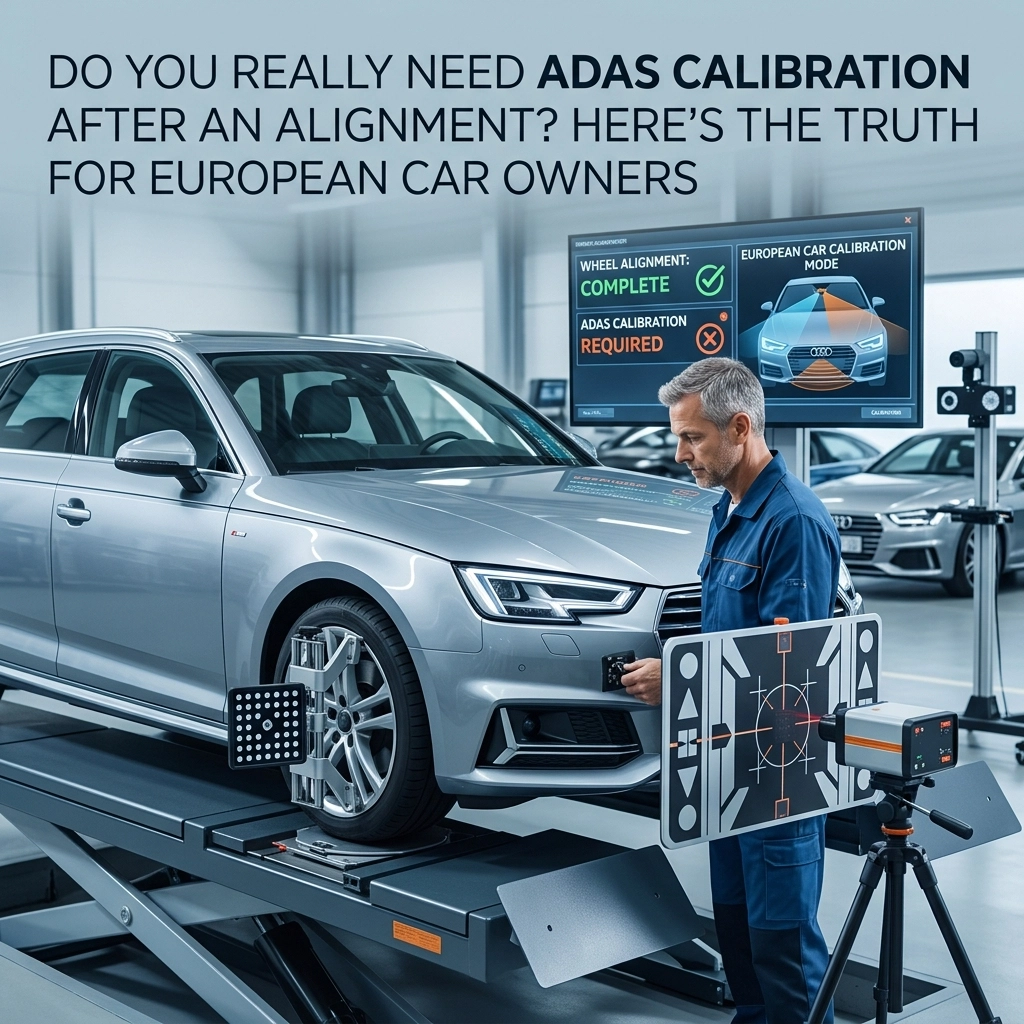
You’ve likely been there: cruising down the SH-130 in your BMW or Mercedes, enjoying that tight, German-engineered handling, when you notice the steering wheel is just a hair off-center. Or maybe you’ve recently hit one of those notorious Texas potholes and noticed your Audi is pulling slightly to the right. Naturally, you think, “I just need a quick wheel alignment.” In the old days: say, back in 2010: you’d be right. You’d drop your car off at a European auto repair shop, the technician would adjust your tie rods, and you’d be back on the road in an hour. But if you’re driving a modern European vehicle equipped with Advanced Driver Assistance Systems (ADAS), an alignment is no longer a “set it and forget it” mechanical job. Today, if you align the wheels without calibrating the “eyes” of the car, you might be setting yourself up for a digital headache: or worse, a safety hazard. At United Euro, our master technicians, Moe and Felix, see this confusion all the time. Let’s break down the truth about why ADAS calibration isn’t just an “upsell”: it’s a safety necessity for every modern Audi, BMW, Mercedes, and VW owner in Pflugerville. What is ADAS, and Why Does Your Car Have So Many “Eyes”? Before we dive into the mechanical weeds, let’s define the tech. ADAS stands for Advanced Driver Assistance Systems. These are the features you’ve grown to love (and perhaps occasionally argue with): Adaptive Cruise Control: Keeping you at a safe distance from the truck in front of you. Lane Keep Assist: Gently nudging your steering wheel if you drift. Automatic Emergency Braking: Slamming on the anchors if a pedestrian steps out. Blind Spot Monitoring: Those little orange triangles in your mirrors. These systems rely on a complex network of cameras (usually behind the rearview mirror), radar sensors (often hidden in the front grille or bumper), and ultrasonic sensors. For these systems to work, they need to know exactly where the car is pointing. The Technical Connection: Why Alignment and ADAS are Inseparable Think of your car’s wheel alignment as its “posture” and the ADAS sensors as its “vision.” When we perform a wheel alignment, we are adjusting the angles of the wheels so they are parallel to each other and perpendicular to the ground. We specifically look at the Thrust Angle: the direction the rear wheels are pointing. In a perfect world, the rear wheels push the car exactly down the center of the chassis. However, when a technician adjusts your alignment, they are fundamentally changing the “Thrust Line” of the vehicle. If the wheels were pointing even 0.5 degrees off before, and now they are perfectly straight, the physical direction of the car has changed. The “Crooked Glasses” Analogy Imagine you’re wearing a pair of high-tech augmented reality glasses that highlight the path you should walk on. If someone nudges those glasses just two millimeters to the left, you’re going to start walking into walls, even if your feet are pointed straight ahead. That is exactly what happens to your BMW or Mercedes. If the alignment changes but the front-facing camera isn’t recalibrated to the new “straight,” the car’s computer thinks it’s heading one way while the wheels are actually taking it another. This is why what you should know about wheel balancing and alignment often involves more than just the tires. The Risks: What Happens if You Skip Calibration? Skipping ADAS calibration after an alignment isn’t just a technical oversight; it has real-world consequences on the roads of Pflugerville. 1. “Ghost” Emergency Braking This is perhaps the most frightening scenario. If your radar sensor is misaligned by even a fraction of a degree, it might perceive an overhead bridge or a car in the adjacent lane as an obstacle directly in your path. Your car might suddenly slam on the brakes at highway speeds for no apparent reason. 2. Lane Drift and Fighting the Wheel If your Lane Keep Assist thinks the “center” of the lane is three feet to the left of where it actually is, you’ll find yourself constantly fighting the steering wheel. The car will try to “correct” your position into oncoming traffic or the shoulder because its digital map doesn’t match its physical orientation. 3. False Warnings and System Failure Modern European ECUs (Electronic Control Units) are incredibly smart. If the data from the Steering Angle Sensor (SAS) doesn’t match the data from the camera and radar, the system may get “confused” and shut down entirely, lighting up your dashboard like a Christmas tree. The European Difference: Audi, BMW, and Mercedes Specs At United Euro, we specialize in German engineering. Why does that matter for ADAS? Because brands like Audi and Mercedes-Benz have some of the tightest tolerances in the industry. BMW Repair Shop Insights: On most modern BMWs, the Steering Angle Sensor must be reset during an alignment. If the car has Active Steering, the calibration is even more intensive. We use factory-quality diagnostics to ensure the electronic “zero point” matches the mechanical “zero point.” Mercedes Service Center Standards: Mercedes-Benz vehicles often use a “Distronic” radar system. If the bumper was removed or the alignment was adjusted, the radar must be recalibrated using specific targets to ensure the Adaptive Cruise Control doesn’t fail. Audi Specialist Perspective: Audi’s “Pre-Sense” system is highly integrated. An Audi specialist near me (that’s us!) knows that even a minor suspension tweak requires a look at the camera calibration to ensure your safety features remain functional. How United Euro Handles Calibration Many general repair shops in the Austin area will perform an alignment but then tell you to “go to the dealer” for the ADAS work. This is because ADAS calibration requires a massive investment in specialized equipment and training. Moe and Felix, our master technicians, don’t believe in half-measures. When you bring your vehicle to United Euro, we use bi-directional controls to talk directly to your car’s computer. We utilize specialized targets and laser-guided levels to ensure that
5 Warning Signs You Need Brake Repair Services Now

You’re cruising through Pflugerville, perhaps heading toward a weekend getaway or simply navigating the daily commute in your BMW or Honda. You press the brake pedal to slow down for a red light, and for a split second, there’s a flicker of hesitation. Maybe it’s a faint squeak, or perhaps the pedal feels just a bit softer than it did last month. In a high-performance European machine or a precision-engineered Asian vehicle, the braking system is your most critical safety feature. It is the literal line between a controlled stop and a dangerous collision. Yet, because brake wear is often gradual, many drivers subconsciously adapt to failing performance until it’s too late. At United Euro, we believe that maintaining your vehicle shouldn’t involve guesswork. With over 25 years of excellence and a team led by Certified Master Technicians Moe and Felix, we’ve seen how small warning signs can escalate into costly repairs. Understanding these five warning signs isn’t just about vehicle maintenance; it’s about protecting your investment and your family. 1. The Auditory Alarm: Squealing, Chirping, or Grinding Your car is designed to talk to you. When it comes to the braking system, the first “conversation” usually involves high-pitched noises. Most modern brake pads are equipped with a small metal shim called a wear indicator. When the friction material on the pad wears down to a specific thickness: usually around 2-3mm: this metal shim makes contact with the rotor, producing a distinct squealing or chirping sound. This is an intentional “early warning” designed by engineers to tell you that you need brake repair services within the next few weeks. However, if that squeal evolves into a heavy, metallic grinding sound, you have entered the danger zone. Grinding indicates that the friction material is completely gone. You are now experiencing metal-on-metal contact between the brake caliper and the rotor. For owners of European brands like BMW or Audi, this is particularly critical. European braking systems often utilize softer rotor compounds to achieve superior stopping power and “bite.” When you allow pads to reach the grinding stage, you aren’t just replacing pads; you are likely destroying the rotors and potentially damaging the calipers. In our European auto repair facility, we prioritize catching these issues early to save you the expense of a full system overhaul. 2. The Spongy or Soft Brake Pedal The braking system in your vehicle is a closed hydraulic circuit. When you press the pedal, you are moving brake fluid through lines to engage the calipers. If the pedal feels “spongy,” “mushy,” or sinks all the way to the floorboard, the hydraulic integrity has been compromised. There are three primary culprits for a soft pedal: Air in the Lines: Air is compressible; brake fluid is not. If air enters the system, your foot’s pressure is spent compressing air bubbles rather than moving the brake pads. Moisture Contamination: Brake fluid is hygroscopic, meaning it absorbs moisture from the air over time. This moisture lowers the boiling point of the fluid. Under heavy braking, the water can turn into vapor, creating that “spongy” feel and reducing stopping power. Master Cylinder Failure: Think of the master cylinder as the “heart” of your braking system. If the internal seals fail, the pressure required to stop your car will bleed off internally. Whether you drive a high-revving Honda or a luxury Mercedes, a soft pedal is a non-negotiable safety hazard. At United Euro, we utilize expert diagnostics to pinpoint exactly where the pressure loss is occurring, ensuring your “pedal feel” is restored to factory specifications. 3. Vibrations and Shaking During Deceleration If your steering wheel shudders or your brake pedal pulsates when you apply pressure, you are likely dealing with “warped” rotors. Technically known as lateral runout or thickness variation, this occurs when the surface of the brake rotor is no longer perfectly flat. Rotors are subject to immense thermal stress. Repeated heavy braking generates heat that can reach over 1,000 degrees Fahrenheit. If the rotors cannot dissipate this heat effectively, or if they are subjected to sudden cooling (like driving through a deep puddle after a long descent), the metal can distort. For Pflugerville drivers, this isn’t just an annoyance; it’s a performance killer. A vibrating rotor prevents the brake pads from making consistent, even contact. This reduces the friction coefficient and increases the time it takes to stop. As a specialized BMW repair shop and Honda repair shop, we see this often. We don’t just “slap on pads”; we measure rotor runout with precision instruments to ensure a vibration-free experience. 4. The “Pull” to One Side When you apply the brakes, your car should maintain a straight path. If the vehicle tries to dive into the left or right lane, you have an imbalance in your braking force. This “pulling” sensation usually points to a “stuck” or “frozen” brake caliper. In a healthy system, the caliper pistons move outward to press the pads against the rotor and then retract slightly when you release the pedal. If a caliper piston becomes seized due to corrosion or debris, it may stay engaged (causing the car to pull toward that side) or fail to engage entirely (causing the car to pull toward the opposite, working side). Other causes can include a collapsed brake hose that acts as a one-way valve, or unevenly worn pads. This behavior is especially dangerous in wet or slippery conditions, where an imbalanced brake force can trigger a skid. Our team, led by Moe and Felix, treats this as a holistic issue, checking everything from the hydraulic lines to the wheel balancing to ensure your car tracks straight and true. 5. Increased Stopping Distance and “Fading” Physics is unforgiving. If your car takes noticeably longer to come to a complete stop, your braking efficiency has dropped. This is often the result of “brake fade.” Brake fade occurs when the friction components (pads and rotors) can no longer convert kinetic energy into heat effectively. This can happen because the pads have
How United Euro Makes Auto Repair Convenient with Online Scheduling

In today’s fast-paced world, convenience is king. Whether you’re juggling work, family, or personal commitments, every minute counts. This is especially true when it comes to auto repair services. Nobody wants to spend hours on hold or drive across town just to schedule a car service. Fortunately, United Euro in Pflugerville, TX, is revolutionizing the way we approach auto repair by offering an online scheduling system that makes booking a breeze. In this post, we’ll dive into how this innovative service works and why it’s a game-changer for European and Asian vehicle owners. Embracing Technology for Auto Repair The Shift to Digital Solutions The automotive industry is no stranger to technological advancements. From electric cars to advanced diagnostic tools, technology plays a crucial role in how vehicles are maintained and repaired. Online scheduling is an extension of this trend, offering a modern solution to an age-old problem: the hassle of booking a repair appointment. Consider the typical scenario of a working parent in Pflugerville who needs to schedule a service for their BMW. Traditionally, this might involve making multiple phone calls during a busy day, trying to find a time that fits into both their schedule and the garage’s availability. With United Euro’s online system, this becomes a matter of a few clicks, drastically cutting down on wasted time. United Euro’s Digital Leap United Euro has embraced this shift wholeheartedly. By integrating an online scheduling system, they have streamlined the customer experience. This system allows customers to book services from the comfort of their homes, making the process both simple and efficient. This is particularly beneficial for busy individuals who may find it challenging to call during conventional business hours. For instance, a tech-savvy college student with a tight schedule can quickly book a necessary oil change for their Honda at midnight without disrupting their daytime commitments. This kind of flexibility is invaluable and underscores the importance of adapting to digital solutions in customer service. How Online Scheduling Works Navigating the User-Friendly Platform Booking an appointment with United Euro is straightforward. Their website features a user-friendly interface where customers can easily select the type of service they need, choose a preferred date and time, and even specify any additional details about their vehicle. This intuitive process ensures that even those who are not tech-savvy can navigate the platform with ease. Additionally, this system reduces errors by allowing customers to input specific details about their vehicle, such as the make, model, and any known issues. This upfront communication helps avoid potential misdiagnoses and ensures the mechanics have the right tools and parts ready, minimizing delays. Tailoring Services to Your Needs One of the standout features of United Euro’s online scheduling system is its ability to tailor services to individual needs. Customers can specify their car make and model, the specific issues they’re experiencing, and any other relevant details. This ensures that the mechanics are well-prepared and that the service is as efficient as possible. For instance, if a customer notices a strange noise coming from their Audi, they can note this in their booking. This allows the technicians to prepare by having relevant diagnostic tools on hand, expediting the repair process. Such tailored service not only improves efficiency but also enhances customer satisfaction. Benefits of Online Scheduling Save Time and Avoid Hassle Gone are the days of waiting on hold or playing phone tag with a busy service center. With online scheduling, you can book an appointment in just a few clicks. This not only saves time but also reduces the frustration often associated with arranging auto repairs. Moreover, the financial implications of time savings can be significant. For example, business owners who can’t afford to spend time away from their work can now easily fit car maintenance into their busy schedules. This time management efficiency translates into cost savings, as less time is spent coordinating logistics and more on productive activities. Enhanced Customer Experience The convenience of online scheduling enhances the overall customer experience. By removing barriers to booking, United Euro ensures that customers feel valued and heard. This level of service fosters trust and loyalty, crucial components in the auto repair industry where reliability is paramount. Imagine a scenario where a customer experiences a sudden brake issue. Instead of stressing about finding time to make a call, they can schedule an urgent appointment online and receive prompt service. This seamless experience builds confidence in the service provider and encourages repeat business. Practical Examples and Local Insights Meeting the Needs of Pflugerville Residents Living in Pflugerville, TX, comes with its unique set of challenges, not least of which is the unpredictable weather that can affect your vehicle. Whether it’s a sudden cold snap or a blistering heatwave, ensuring your car is in top condition is vital. United Euro’s online scheduling system allows residents to quickly book necessary services, ensuring their vehicles are ready for whatever Mother Nature throws their way. For instance, during the hot Texan summers, your car’s cooling system becomes crucial. Rather than waiting for an overheating engine to force a visit to the mechanic, proactive scheduling of a cooling system check can prevent costly repairs later. This kind of preventative maintenance not only saves money but also avoids the inconvenience of unexpected breakdowns. Seasonal Tips for Vehicle Maintenance Seasonal changes can have a significant impact on vehicle maintenance needs. For instance, scheduling a tire check before the wet season or ensuring your air conditioning is functioning before the summer heat hits can save you time and prevent breakdowns. United Euro’s platform makes it easy to plan these essential services around your schedule. Preparing for winter might involve checking your battery and antifreeze levels, while summer preparation could include an air conditioning system tune-up. Each of these preventative steps can save hundreds of dollars in potential repair costs. Knowing what to expect each season helps drivers maintain their vehicles more effectively, extending the lifespan of their cars and ensuring safety on the road. United Euro’s Commitment to
What to Expect in a Multi-Point Inspection at United Euro

Owning a vehicle is more than just getting from point A to point B—it’s an investment in safety, reliability, and long-term performance. Proper maintenance ensures your car continues to operate efficiently while avoiding costly repairs down the road. At United Euro, we understand the importance of keeping your vehicle in peak condition. That’s why we offer comprehensive multi-point inspections designed to detect issues early and provide you with peace of mind on the road. So, what exactly happens during a multi-point inspection, and why is it essential for your vehicle? Let’s break it down. Understanding the Multi-Point Inspection Think of a multi-point inspection as a complete health check-up for your car. Similar to a doctor’s examination, it involves a thorough evaluation of your vehicle’s systems and components to ensure everything is functioning as it should. By identifying potential problems early, a multi-point inspection can save you from unexpected breakdowns, costly repairs, and safety risks. At United Euro, our inspections go beyond a basic check. We combine technical expertise with advanced diagnostic tools to provide a detailed assessment of your car’s condition. Whether you drive a European luxury sedan, an Asian compact, or a high-performance sports car, our team is equipped to handle your vehicle with precision and care. Key Components of a Multi-Point Inspection A multi-point inspection at United Euro covers a wide range of systems and components to ensure your vehicle is safe, reliable, and performing at its best. Here’s a closer look at what we check: 1. Fluids Check Proper fluid levels and quality are essential for the smooth operation of your vehicle. During an inspection, we examine: Engine Oil: We check the level and condition, ensuring your engine is properly lubricated to prevent wear and overheating. Coolant: Adequate coolant prevents engine overheating and maintains optimal temperature. Brake Fluid: Ensures your braking system responds effectively when needed. Transmission Fluid: Maintains smooth gear shifts and prolongs transmission life. Power Steering Fluid: Keeps steering responsive and effortless. Windshield Washer Fluid: Ensures clear visibility, especially in adverse weather conditions. 2. Tire Inspection Your tires are the only part of your vehicle that touch the road, making them critical for safety and performance. We check: Tread Depth: Proper tread ensures traction in all weather conditions. Air Pressure: Correct inflation improves fuel efficiency and extends tire life. Overall Condition: Detects signs of damage, punctures, or uneven wear that could affect handling. 3. Braking System Safety begins with reliable brakes. Our technicians inspect: Brake Pads and Rotors: Evaluating wear to ensure effective stopping power. Brake Lines and Hoses: Checking for leaks or damage that could compromise braking performance. 4. Battery Health A failing battery can leave you stranded. We test the battery’s charge, examine connections for corrosion, and ensure it can reliably start your vehicle. 5. Lighting and Electrical Systems Proper lighting is essential for safe driving. Our inspection includes: Headlights and Taillights: Ensuring visibility in all conditions. Indicators and Hazard Lights: Confirming correct signaling function. Dashboard Warning Lights: Identifying any issues indicated by warning signals. 6. Suspension and Steering Your vehicle’s suspension and steering systems are key to comfort and handling. We inspect: Shock Absorbers and Struts: Checking for wear to maintain a smooth ride. Steering Components: Ensuring responsive and stable steering without excessive play. 7. Exhaust System A well-maintained exhaust system keeps your vehicle performing efficiently while reducing harmful emissions. We check for leaks, rust, or damage that could affect performance or safety. 8. Visual Inspection Finally, we perform a detailed visual inspection of your vehicle’s undercarriage, exterior, and frame to detect signs of damage, rust, or other structural concerns. Why Choose United Euro for Your Multi-Point Inspection? United Euro is more than just an auto repair shop—we are a trusted partner for European and Asian vehicle owners in Pflugerville, TX. Here’s what sets us apart: Certified Industry Experts: Our technicians are highly trained, including Honda/Acura Master Technician certification and tire manufacturer certifications. Every inspection is handled by skilled professionals who understand your vehicle inside and out. Advanced Diagnostics: We use state-of-the-art diagnostic equipment to accurately identify issues that may not be visible during a standard inspection. Specialized European and Asian Vehicle Service: Our team specializes in European and Asian makes, ensuring repairs and maintenance are precise, reliable, and tailored to your vehicle. Flexible Financing Options: With partners like Synchrony, SNAP Finance, and Acima, we make it easy to finance services when needed. Extended Service Contracts Accepted: We work with manufacturer-backed and third-party extended service contracts to provide a hassle-free experience. 25+ Years of Excellence: With decades of combined experience, United Euro has earned a reputation for consistent, high-quality service. Benefits of Regular Multi-Point Inspections Scheduling regular multi-point inspections provides numerous advantages: Preventive Maintenance: Identifying issues early prevents costly repairs and keeps your car running smoothly. Enhanced Safety: Ensures brakes, tires, lights, and other critical systems function correctly. Improved Performance: Keeps your engine, suspension, and drivetrain operating at peak efficiency. Resale Value: A documented history of inspections and maintenance increases your vehicle’s resale or trade-in value. Regular inspections are a proactive approach to car care, ensuring you avoid emergency repairs and extend the life of your vehicle. At United Euro, we provide detailed reports and recommendations, so you understand exactly what your vehicle needs. A multi-point inspection at United Euro is more than just a routine check-up. It is a comprehensive, professional evaluation of your vehicle’s health, performed by experts who care about your car as much as you do. By investing in regular inspections, you protect your vehicle, enhance safety, and enjoy better performance for years to come. Schedule your next multi-point inspection with United Euro in Pflugerville, TX, and experience the difference in precision, expertise, and personalized care. Let our certified technicians ensure your vehicle remains safe, reliable, and ready for the road ahead.
Why Oil Changes at United Euro Are More Than Just a Drain-and-Fill

When it comes to maintaining your vehicle, regular oil changes are often touted as the cornerstone of engine health. However, not all oil change services are created equal. At United Euro in Pflugerville, TX, an oil change is more than just a routine drain-and-fill. It’s a comprehensive service that ensures your vehicle runs smoothly for miles to come. In this post, we’ll delve into what makes an oil change at United Euro stand out and why it’s essential for European and Asian vehicle owners. Understanding the Basics of an Oil Change What Is an Oil Change? An oil change involves removing the old, dirty oil from your engine and replacing it with fresh, clean oil. It’s a simple concept but crucial for keeping your engine lubricated and running efficiently. Without regular oil changes, the oil can become contaminated with dirt and debris, leading to increased wear and tear on engine components. Imagine driving through the dusty roads of Texas with neglected oil; your engine would suffer and performance would plummet. Regular oil changes are your first line of defense against engine damage. The United Euro Approach At United Euro, we take the standard oil change to the next level. Our service includes a detailed inspection of your vehicle’s key systems to ensure everything is functioning as it should. This proactive approach helps identify potential issues before they become costly problems. For instance, during a routine oil change, we might discover a small leak in a hose that could lead to a larger issue if left unchecked. Early detection saves you from unexpected breakdowns and expensive repairs. It’s not just about changing oil; it’s about ensuring overall vehicle health. The Importance of Using the Right Oil Conventional vs. Synthetic Oil Choosing the right type of oil is critical for your vehicle’s performance. Conventional oil is typically cheaper, but synthetic oil offers superior protection and performance. At United Euro, we recommend synthetic oil changes for most European and Asian vehicles due to their advanced engine designs. Synthetic oils provide better lubrication, especially under extreme temperatures – a crucial factor given Texas’s hot summers. While synthetic oil might cost more upfront, it offers better long-term protection and efficiency, potentially saving you money by extending the life of your engine. Why Quality Matters Not all oils are created equal. High-quality synthetic oil provides better viscosity, thermal stability, and reduced engine deposits. This means your engine runs smoother and more efficiently, prolonging its lifespan. Our technicians at United Euro are trained to select the best oil for your specific make and model. For instance, a high-performance vehicle like a BMW or a Lexus demands precise oil specifications to maintain its peak performance. Using subpar oil can lead to gradual damage and costly repairs. Investing in quality oil is an investment in your vehicle’s future. Comprehensive Inspection with Every Oil Change More Than Just Oil When you bring your vehicle to United Euro, you’re not just getting an oil change. Our technicians conduct a thorough inspection of your vehicle, checking everything from fluid levels to the condition of your belts and hoses. This comprehensive approach ensures that your vehicle remains in top condition. Imagine planning a road trip without realizing your brake fluid is low or your serpentine belt is worn out. Our inspections are designed to catch such potential issues, offering peace of mind on the road. Identifying Potential Issues During the inspection, our team looks for signs of wear and tear that could lead to bigger problems down the road. Catching these issues early can save you time and money, and keep your vehicle running safely. For example, discovering a worn-out timing belt during an oil change can prevent a catastrophic engine failure later. Regular inspections are a smart way to avoid unexpected and costly repairs. By addressing small issues promptly, you extend the life of your vehicle and enhance its performance. Seasonal Tips for Oil Changes Adjusting for Weather Conditions Texas weather can be unpredictable, and it’s important to adjust your vehicle maintenance accordingly. In the hotter months, your engine works harder, making it vital to ensure your oil is in good condition. Regular oil changes at United Euro help your vehicle cope with temperature extremes. Consider the impact of heat on engine oil, which can thin out and lose its effectiveness faster. By scheduling seasonal oil changes, you ensure optimal engine performance and prevent overheating. Preparing for Road Trips If you’re planning a road trip, an oil change can give you peace of mind. Before you hit the open road, make a pit stop at United Euro to ensure your vehicle is ready for the journey ahead. A comprehensive check-up can reveal potential issues such as tire wear or low coolant levels, which are crucial for long-distance travel. Pre-trip inspections can prevent inconvenient breakdowns and keep your travel plans on track. Local Expertise and Personalized Service Why Choose United Euro? Located in Pflugerville, TX, United Euro is your neighborhood expert in European and Asian vehicles. Our technicians are highly trained and experienced, offering personalized service tailored to your vehicle’s needs. We understand the unique requirements of different makes and models, ensuring that each vehicle receives the care it deserves. Our community-centric approach fosters trust and reliability, making us the preferred choice for local car owners. Building Trust with Our Customers We believe in building long-term relationships with our clients. By providing honest, reliable service, we aim to be the go-to shop for all your automotive needs. When you choose United Euro, you’re choosing a partner in your vehicle’s care. Our commitment to transparency and quality service ensures that you receive the best care without unnecessary upsells. We prioritize your needs and vehicle requirements, focusing on what truly matters for your car’s performance and longevity. The Role of Regular Maintenance in Vehicle Longevity Extending Engine Life Regular oil changes are a critical component of vehicle maintenance. By ensuring your engine is always running with clean oil, you’re helping to extend its life.
What You Should Know About Wheel Balancing – Backed by United Euro Experts

When was the last time you thought about the balance of your wheels? For many vehicle owners, wheel balancing is an overlooked aspect of car maintenance. However, it plays a crucial role in ensuring a smooth and safe driving experience. In this guide, you’ll discover the ins and outs of wheel balancing, why it’s essential, and how United Euro can help keep your wheels in top condition. What is Wheel Balancing? Wheel balancing involves adjusting the weight distribution around your car’s wheels. This ensures that the wheels spin smoothly at high speeds. Unbalanced wheels can lead to vibrations, uneven tire wear, and even damage to your vehicle’s suspension. The Basics of Wheel Balancing Wheel balancing is achieved by placing small weights on the rim of the wheel. These weights counteract any imbalances in the tire and wheel assembly. A wheel balancer machine is used to measure the imbalance and determine the correct placement of weights. This process requires precision and expertise, as incorrect balancing can lead to further issues. Consider a scenario where you’re driving on a highway, and you begin to feel a persistent vibration through the steering wheel. This is often a clear sign that your wheels are out of balance. It’s not just about comfort; these vibrations can cause components of your car to wear prematurely, leading to more significant repairs down the road. Why Is It Necessary? Over time, everyday driving can cause wheels to become unbalanced. This can happen due to normal wear and tear, hitting potholes, or after a tire replacement. Balanced wheels are crucial for maintaining a smooth ride, improving fuel efficiency, and extending the life of your tires. Imagine driving through a city riddled with potholes. Each impact can slightly shift the weight distribution of your wheels, causing imbalance. This is why regular checks and balances are crucial. Signs You Need Wheel Balancing Recognizing when your wheels need balancing can save you from costly repairs and improve your driving experience. Vibrations While Driving One of the most common signs of unbalanced wheels is vibrations in the steering wheel or seat. This usually occurs at specific speeds and can make driving uncomfortable. Imagine planning a road trip and halfway through, your hands are numb from the constant vibrations; this is not just inconvenient but could also indicate a larger underlying issue. Uneven Tire Wear If you notice that your tires are wearing unevenly, it might be time for a wheel balance. Unbalanced wheels cause certain areas of the tire to wear down faster than others, reducing their lifespan. Regularly checking your tire tread can prevent this. A penny test, where you insert a penny into the tread with Lincoln’s head upside down, can help determine if the tire tread is too low and may need attention. Strange Noises Unusual noises, such as humming or thumping, can indicate that your wheels are unbalanced. These noises are often more noticeable when driving at higher speeds. If left unaddressed, these noises can become more pronounced and lead to further mechanical issues. The Wheel Balancing Process Understanding what happens during a wheel balancing service can help you appreciate its importance. Inspection and Diagnosis The first step is a thorough inspection of the wheels and tires. Technicians look for visible signs of damage or wear that might contribute to imbalance. For instance, if a tire has a bulge or a nail stuck in it, these need to be addressed before balancing can be effectively carried out. Using the Balancer Machine The wheel is mounted on a balancer machine, which spins the wheel and measures its balance. The machine detects any imbalance and suggests where weights should be placed. This high-tech equipment ensures that the balancing is precise, contributing to a smoother ride and less wear on your tires. Applying Weights Once the imbalance is detected, weights are applied to the rim to achieve perfect balance. These weights are usually made of metal and can be clipped or stuck onto the wheel. It’s a meticulous process that requires attention to detail, ensuring each wheel is perfectly balanced. Benefits of Regular Wheel Balancing Regular wheel balancing offers several benefits that enhance your driving experience and vehicle health. Improved Ride Comfort Balanced wheels reduce vibrations and provide a smoother ride. This makes driving more enjoyable and less tiring, especially on long trips. Imagine cruising down the highway with no vibrations, just a smooth, quiet drive. Enhanced Fuel Efficiency When wheels are balanced, your car moves more efficiently, reducing the amount of fuel needed to power it. This can save you money at the pump over time. By ensuring your wheels are balanced, you could see a modest improvement in fuel economy, saving you hundreds of dollars annually, depending on your driving habits. Prolonged Tire Life Balanced wheels ensure even tire wear, which can extend the life of your tires. This means fewer replacements and lower maintenance costs in the long run. How Often Should You Balance Your Wheels? Knowing when to balance your wheels can prevent issues before they become serious. Routine Maintenance Schedule It’s recommended to balance your wheels every 5,000 to 6,000 miles or whenever you rotate your tires. This ensures that any imbalance is corrected regularly. Integrating wheel balancing into your regular maintenance schedule can prevent small issues from escalating into major repairs. After Tire Changes or Repairs Anytime you get new tires or have your tires repaired, it’s a good idea to have them balanced. This will ensure that the new setup is as smooth as possible. It’s a proactive approach that can save you from headaches later on. Why Choose United Euro for Wheel Balancing? United Euro in Pflugerville, TX, offers expert wheel balancing services that keep your vehicle running smoothly. Expertise and Technology United Euro uses state-of-the-art technology and skilled technicians to ensure precise wheel balancing. Their expertise ensures that your vehicle is in good hands. By choosing a reputable service provider, you’re ensuring quality and precision that can make all the difference in
How Often Should You Change Your Oil? A Guide for Smithers Drivers

As a driver in Smithers, you might often wonder about the right frequency for changing your vehicle’s oil. Regular oil changes are crucial for maintaining your car’s performance and longevity. This guide will help you understand how often you should change your oil, taking into account various factors such as vehicle type, driving conditions, and climate influences specific to Smithers. By the end of this guide, you’ll have a clear understanding of your vehicle’s oil change needs and how United Euro can help you keep your car in top shape. Why Oil Changes Are Crucial for Your Vehicle An oil change is more than just routine maintenance; it’s essential for your vehicle’s health. The oil in your car serves several critical functions: – Lubrication of Engine Parts: Oil reduces friction between the moving parts of your engine, preventing wear and tear. Think of oil as the blood of your vehicle, ensuring that all components move smoothly and efficiently without grinding against each other. Just as a marathon runner needs well-lubricated joints to perform optimally, so does your engine. – Heat Reduction: It helps in dissipating heat, keeping the engine cool and preventing overheating. Imagine trying to run a marathon in the heat of summer without any water; your engine would similarly overheat without proper lubrication. – Contaminant Removal: Oil carries away dirt and debris, which could otherwise damage the engine. Picture a vacuum cleaner bag that, once full, starts spewing dust back into the air; dirty oil can similarly circulate contaminants that harm your engine. Neglecting these functions can lead to significant engine damage and costly repairs. Depending on the vehicle and extent of damage, engine repairs can range from $500 to over $5,000. Signs You Need an Oil Change Keeping an eye out for certain signs can help you know when it’s time for an oil change: – Dirty or Dark Oil: Check the oil color; if it’s dark or dirty, it’s time for a change. Just like how a cup of clear water turns murky when mixed with dirt, clean oil turns dark as it gathers impurities. – Loud Engine Noise: If your engine sounds louder than usual, this might indicate that the oil is no longer effectively lubricating engine parts. A well-oiled engine purrs like a content cat, whereas an engine in need of an oil change may growl and protest. – Oil Change Light: Always heed the dashboard light indicating it’s time for an oil change. This light is like a smoke alarm, warning you of potential problems before they escalate. Preventative Maintenance Tips To avoid these warning signs, regularly check your oil level and quality. Keeping a small supply of the recommended oil for your vehicle in your garage can help you top off the oil if necessary, which is a simple way to extend the time between changes. Traditional Oil Change Intervals The often-quoted rule of thumb is to change your oil every 3,000 miles. However, advances in engine technology and oil formulations mean this isn’t always the case. Manufacturer Recommendations Always refer to your vehicle’s manual for manufacturer-specific guidelines. Many modern cars can go between 5,000 to 10,000 miles before needing an oil change. Think of these guidelines as a personalized fitness plan for your car, tailored to keep it running at peak performance. The 3,000-Mile Myth The 3,000-mile rule originated decades ago when engine and oil technology were less advanced. Today, this frequency is often unnecessary and can lead to increased costs and environmental waste. Changing your oil too often is like discarding perfectly good food simply because of an arbitrary expiration date. Cost Considerations Regularly changing oil more frequently than necessary can cost you significantly over time. While an oil change might cost between $30 to $100, unnecessary changes can add up quickly and strain your budget. Factors Influencing Oil Change Frequency Several factors can influence how often you need to change your vehicle’s oil, especially in Smithers: Driving Conditions – Short Trips: Frequent short trips can lead to more frequent oil changes as the engine doesn’t always reach optimal operating temperature. Think of your car as an athlete; it needs a proper warm-up to perform at its best. – Stop-and-Go Traffic: Driving in heavy traffic can increase engine strain, necessitating more frequent oil changes. It’s akin to running in place constantly without making progress, leading to additional wear. Climate and Seasonal Changes Smithers experiences distinct seasons, which can affect oil change frequency: – Cold Winters: Cold starts in winter can thicken oil, making it less effective. Imagine trying to stir a pot of cold honey; it’s sluggish and resistant, just like cold oil. – Hot Summers: High temperatures can cause oil to degrade faster. It’s similar to how the summer sun can cause milk to spoil quicker if left out. Deeper Dive: The Impact of Climate Understanding the impact of Smithers’ climate on your vehicle can guide you in choosing the right type of oil. In colder months, opting for oils with lower viscosity ratings can help ensure that your engine runs smoothly. Conversely, in the heat of summer, oils designed to withstand higher temperatures can prevent degradation. Different Oil Types and Their Impact The type of oil you use can significantly affect your oil change frequency: Conventional vs. Synthetic Oil – Conventional Oil: Typically requires more frequent changes, around every 3,000 to 5,000 miles. It’s like a budget-friendly pair of shoes that gets the job done but needs replacing sooner. – Synthetic Oil: Offers better performance and can last between 7,500 to 10,000 miles before needing a change. It’s the luxury brand option—more expensive upfront but cost-effective over time due to its longevity. High-Mileage Oil For vehicles with over 75,000 miles, high-mileage oil can offer benefits such as reduced oil consumption and minimized leaks. Think of it as a specialized diet plan for older vehicles, catering to their unique needs. Cost Implications While synthetic oils generally have a higher upfront cost, ranging from $70 to $100 per change,